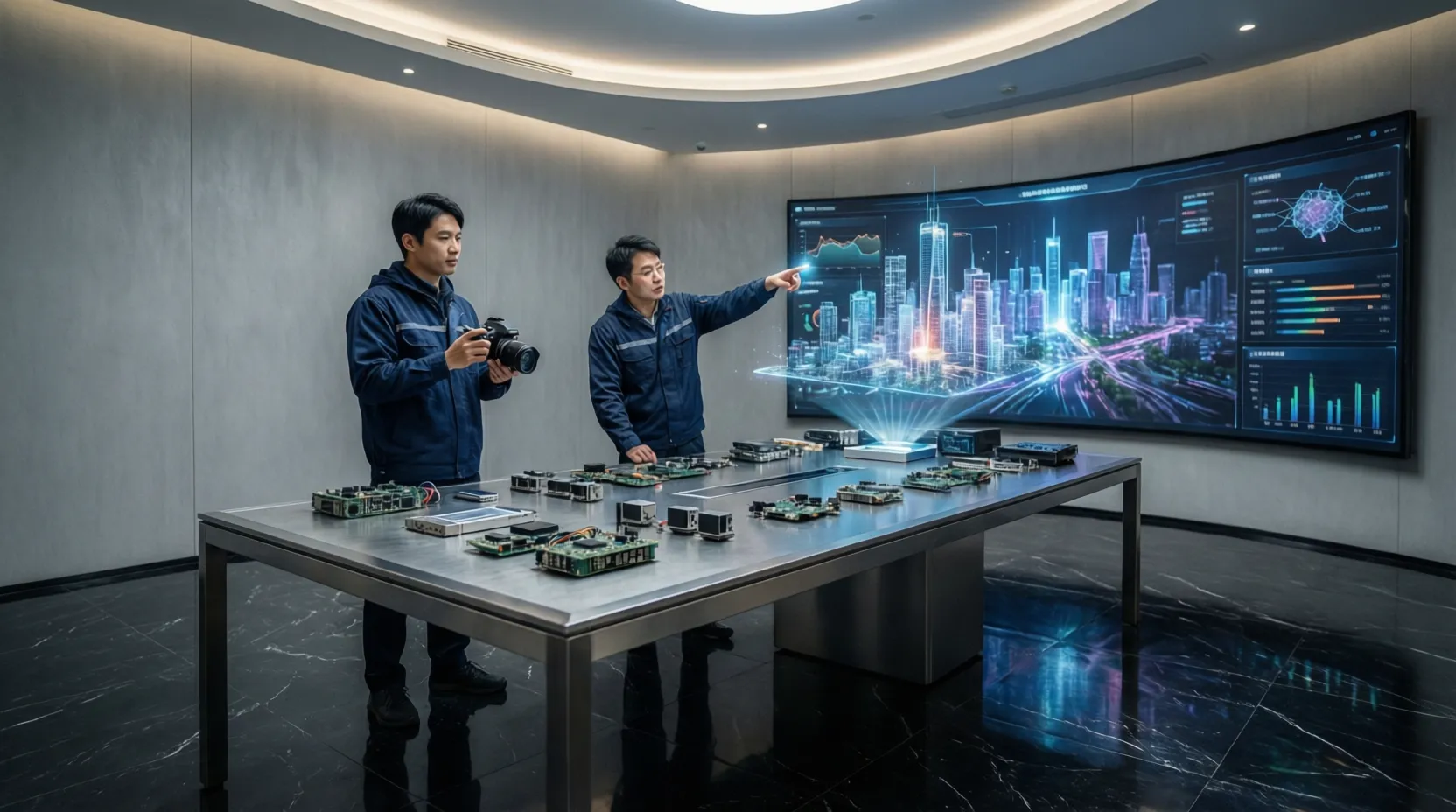
Ouster, a recognized leader in advanced sensing and perception technologies for Physical AI, has officially completed its acquisition of StereoLabs SAS, a pioneer in AI-powered vision and perception solutions. The transaction closed on February 4, 2026, marking a major strategic milestone for Ouster as it expands beyond lidar into a fully integrated, end-to-end sensing and perception platform designed to power real-world autonomy across industries.
With the addition of StereoLabs, Ouster now delivers what it describes as Physical AI’s first truly unified sensing and perception solution—bringing together high-performance digital lidar, stereo cameras, onboard AI compute, sensor fusion and perception software, and state-of-the-art AI models under a single platform. The combined offering is designed to enable machines not only to perceive their environments with greater fidelity, but also to reason, act, and continuously learn in complex physical settings.
Ouster has long been recognized for its leadership in digital lidar technology, supplying high-resolution, reliable sensors used in robotics, industrial automation, smart infrastructure, and autonomous vehicles. However, as Physical AI systems evolve from narrow automation tasks to increasingly autonomous and adaptive behaviors, customers are demanding more than individual sensors—they want tightly integrated perception stacks that reduce development complexity and accelerate deployment.
The acquisition of StereoLabs directly addresses this market shift. Founded in 2010, StereoLabs has built a strong reputation for delivering high-quality 3D vision through its ZED family of stereo cameras and its robust AI perception software. To date, the company has shipped more than 90,000 cameras to over 10,000 customers worldwide, and its software tools are relied upon by a large and active developer community to power production-grade systems in robotics, industrial automation, and smart infrastructure applications.
By bringing StereoLabs’ vision capabilities in-house, Ouster is positioning itself at the center of the Physical AI ecosystem—where perception is no longer siloed by sensor type, but unified through sensor fusion and AI-driven understanding of the physical world.
As part of the transaction, StereoLabs’ co-founders—Cecile Schmollgruber, Edwin Azzam, and Olivier Braun—will continue to lead the StereoLabs team within Ouster. This leadership continuity is intended to preserve the company’s culture of innovation while ensuring stability for customers and developers who rely on StereoLabs’ products.
Ouster has also emphasized its commitment to maintaining continuity across StereoLabs’ product portfolio, global customer base, and developer ecosystem. Existing customers will continue to receive support for ZED cameras and perception software, while developers can expect ongoing investment in tools, SDKs, and AI models.
This focus on continuity reflects Ouster’s broader strategy: rather than absorbing StereoLabs as a standalone acquisition, the company aims to integrate its technologies deeply while preserving the strengths that made StereoLabs successful in the first place.
Industry leaders increasingly agree that the future of autonomy depends on combining complementary sensing modalities rather than choosing between them. Stereo vision excels at capturing dense visual information, texture, and depth at short to medium ranges, while lidar provides precise distance measurement, robustness in challenging lighting conditions, and long-range accuracy. Together, they form a more complete and resilient perception system.
StereoLabs CEO Cecile Schmollgruber underscored this philosophy following the acquisition.
“The future of autonomy isn’t about choosing between vision or lidar—it’s about unifying them,” she said. “By combining StereoLabs’ AI vision with Ouster’s digital lidar, we are creating the world’s most capable perception platform to directly address customers’ primary sensor fusion requirements and enable machines to sense, think, act, and learn in the physical world.”
This unified approach is particularly important as Physical AI systems move into environments where safety, reliability, and adaptability are critical—from humanoid robots operating alongside humans to autonomous machines navigating dynamic industrial sites.
For Ouster, the acquisition represents a natural next step in its evolution from a sensor supplier to a foundational platform provider for Physical AI. CEO Angus Pacala described the deal as both a continuation of the company’s momentum and a catalyst for its next phase of growth.
“StereoLabs is a world-class perception company recognized for its market-leading stereo cameras and AI vision software, making it a natural fit for Ouster’s next stage of growth,” Pacala said. “With seamless sensor fusion, we are addressing the unprecedented pull for both lidar and vision as industries transition from simple automation toward Physical AI.”
According to Pacala, the combined platform simplifies and accelerates customer development cycles, allowing users to move more quickly from prototype to production. By synchronizing and calibrating lidar and stereo camera data out of the box, Ouster reduces engineering overhead while improving perception performance.
The integration also enables the company to pool its investments in AI training and model development, delivering more capable perception software while avoiding duplicated effort.
The acquisition of StereoLabs supports Ouster’s long-term strategy across several key dimensions.
A Comprehensive Single-Source Offering
With StereoLabs onboard, Ouster can now provide customers with a single-source solution for sensing and perception. The platform spans digital lidar, stereo cameras, AI compute, sensor fusion, perception software, and advanced AI models—reducing the need for customers to integrate disparate technologies from multiple vendors.
Accelerated Customer Development
By combining industrial-grade digital lidar with high-density stereo camera data, the unified platform delivers synchronized and calibrated perception data from day one. This enables more accurate object detection, manipulation, navigation, and safety functions while reducing development time and overall system cost.
Enhanced Software and AI Capabilities
The deal strengthens Ouster’s software portfolio by incorporating StereoLabs’ proven AI vision algorithms and development tools. Together, the companies can accelerate software innovation, improve perception accuracy, and deliver more advanced capabilities to customers operating in complex real-world environments.
Expanded Market Reach
The acquisition significantly expands Ouster’s total addressable market across robotics, industrial automation, and smart infrastructure. It also unlocks new high-growth use cases in areas such as humanoid robotics, visual inspection, warehouse automation, and intelligent infrastructure monitoring—applications that rely heavily on advanced vision and perception.
Financial and Stakeholder Value
From a financial perspective, the transaction adds a high-growth, EBITDA-positive business to Ouster’s portfolio. StereoLabs generated approximately $16 million in unaudited revenue in 2025, strengthening Ouster’s financial position and reinforcing its path toward sustained profitability.
As Physical AI continues to reshape industries, the importance of perception cannot be overstated. Machines must be able to understand their surroundings with high confidence, interpret complex scenes, and respond appropriately in real time. Achieving this level of autonomy requires tightly integrated sensing, perception, and AI—not fragmented solutions.
With the acquisition of StereoLabs, Ouster is positioning itself as a foundational technology provider for this new era. By unifying lidar and vision into a cohesive platform, the company aims to lower barriers to adoption, speed innovation, and enable customers to deploy autonomous systems at scale.
Source Link:https://www.businesswire.com/