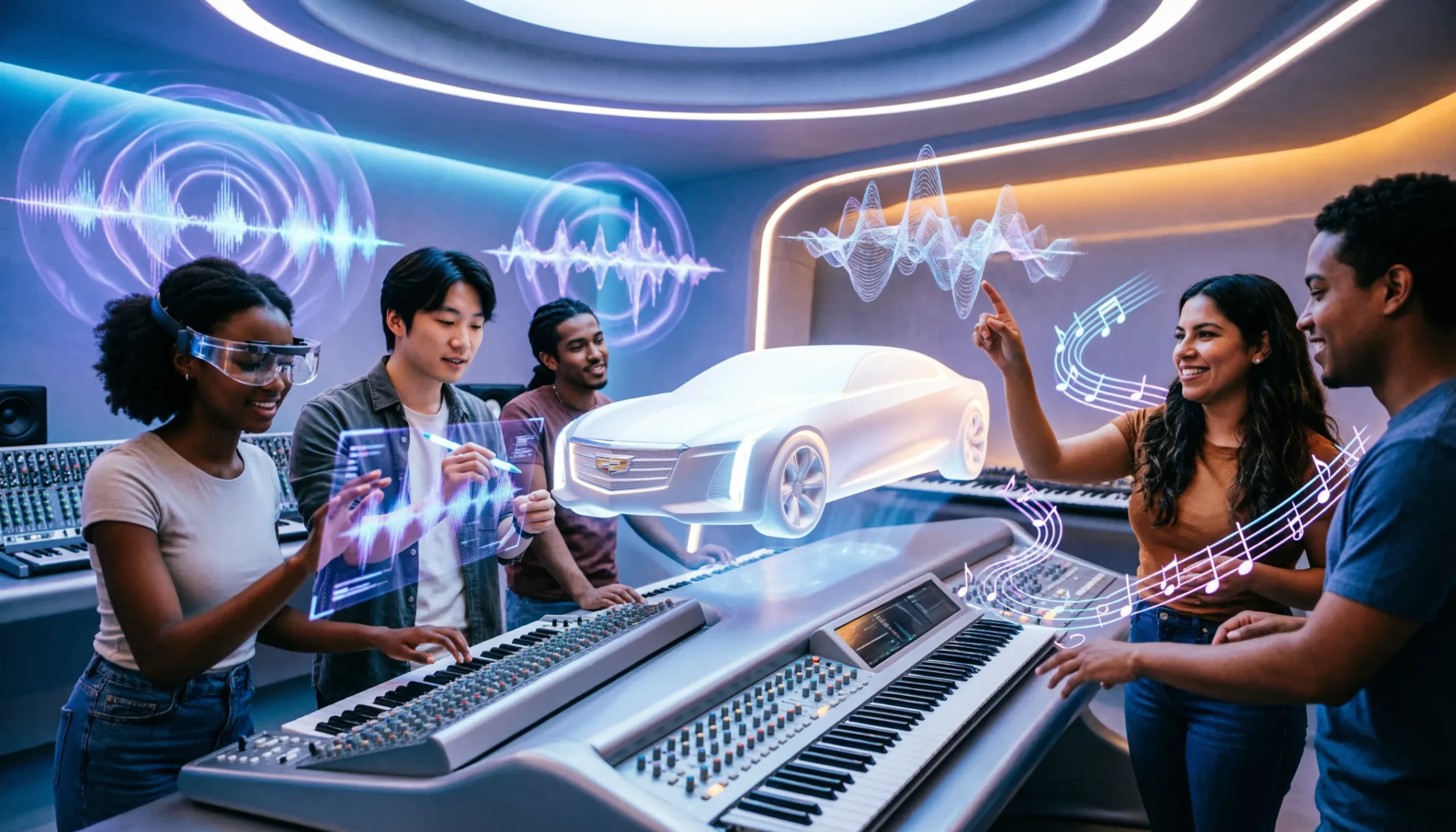
Cadillac’s From Studio Mix to Immersive In-Vehicle Experience
Cadillac’s Music has always had a special relationship with the automobile. Long before streaming platforms and immersive audio formats, artists and producers relied on the “car test” to evaluate how their work translated beyond the controlled walls of a recording studio. That ritual has now entered a new era with the integration of Dolby Atmos inside select Cadillac models, transforming the vehicle cabin into a mobile reference studio where music can be experienced as it was intended to be heard.
Cadillac’s The Passenger Seat: An Overlooked Creative Command Center
From the passenger seat, the role often feels simple—control the playlist, read the mood, and set the vibe. Yet that vantage point offers something far more revealing. With the music flowing through the cabin, every subtle shift in rhythm, harmony, and texture becomes a shared emotional experience. The impact of a beat drop, the placement of a vocal harmony, or the swell of a string section is no longer confined to headphones or studio monitors. Instead, it fills a carefully engineered acoustic space designed to reveal nuance.
This became unmistakably clear during an immersive session in Los Angeles ahead of Cadillac’s appearance at the National Association of Music Merchants conference, better known as National Association of Music Merchants (NAMM). What unfolded was not simply a listening demonstration, but a dynamic exploration of how automotive audio engineering intersects with creative production.
A Cadillac’s Creative Experiment Built on Urgency
At the center of the experience was producer Moritz Braun, who devised a creative challenge that intentionally removed overthinking from the equation. Rather than allowing artists endless hours to refine and tweak, Braun gave a band just 45 minutes to write and record a complete song in a professional studio environment.
The constraint was deliberate. By compressing the timeline, Braun forced instinct to take the lead. Decisions had to be made quickly. Performances had to feel authentic rather than perfected. The goal was to capture energy rather than polish. Once the recording session ended, Braun and his team immediately mixed the track, preserving its spontaneity while preparing it for a radically different listening environment: a Cadillac equipped with Dolby Atmos.
From Studio Walls to the Open Road
The transition from studio to vehicle marked the true beginning of the experiment. The freshly recorded track was played inside the Cadillac Escalade IQ and the Cadillac Optiq, two models engineered to deliver immersive spatial audio through Dolby Atmos integration.
There was no opportunity for revisions before this step. The mix that left the studio was the mix that entered the vehicle. As the music played through the cabin’s multidimensional sound system, the artists encountered their own creation in an entirely new form. Instead of hearing sound emanate from fixed speakers in front of them, they experienced instruments and vocals positioned around and above them, moving through space with deliberate precision.
This was not just louder or clearer audio. It was spatial storytelling.
The Emotional Impact of Immersive Audio
One of the most revealing moments occurred when singer Malavika and musician Biako sat inside the Cadillac Optiq to listen to the track they had just completed. As the music unfolded around them, they leaned forward instinctively, reacting to details they had not fully registered in the studio.
Layers once blended into the background became distinct. Subtle harmonies surfaced with clarity. Textural elements—percussion accents, ambient reverbs, background instrumentation—took on new life when placed within a three-dimensional sound field.
The cabin acted as both amplifier and microscope. It magnified emotional weight while also dissecting technical choices. In that moment, the so-called “car test” transformed from a casual listening tradition into a critical analytical tool.
The Evolution of the Car Test
For decades, producers have relied on car speakers to determine whether a track “translates” well outside of the studio. If it sounded balanced and compelling in a vehicle, it was likely ready for public release. However, the integration of Dolby Atmos within Cadillac models elevates that tradition significantly.
Instead of testing how a stereo mix performs on conventional speakers, artists now evaluate how spatial audio behaves in an acoustically engineered environment. The car becomes less of a quality checkpoint and more of a creative collaborator.
Inside the vehicle, artists can assess spatial balance—how elements are distributed throughout the cabin. They can measure emotional dynamics—whether a chorus feels expansive enough or an intimate verse remains personal. They can even evaluate how silence interacts with the enclosed space, noticing how pauses resonate differently in a vehicle compared to a studio.
Engineering Meets Artistic Expression
Watching these reactions unfold was equally impactful for the engineering team. John Cockburn, chief engineer for the Cadillac Optiq, observed firsthand how years of acoustic research and system tuning influenced real-world creative decisions.
For engineers, sound calibration often revolves around frequency response curves, speaker placement optimization, and digital signal processing algorithms. Yet witnessing artists respond emotionally to that precision reinforces the purpose behind the technical rigor. The meeting point between engineering and artistry becomes visible—and audible.
Every carefully positioned speaker, every calibration adjustment, every refinement in cabin acoustics contributes to an environment where music is not merely played but experienced in its intended dimension.
Conversations That Redefined the Creative Process
Following the in-vehicle listening session, a roundtable discussion brought together Moritz Braun, Grammy-nominated producer Ryan Ulyate, and musician Marlon Funaki. The conversation moved beyond technical observations and into philosophical territory.
Ulyate reflected on how the immersive experience changed his perception of finishing a track. He described how listening in a Cadillac equipped with Dolby Atmos inspired a sense of exploration—an urge to drive further, discover new roads, and let the music guide the journey.
For these creators, the “car test” is no longer a final checkbox before release. It has become an integral step within the creative workflow. Decisions about vocal placement, instrumental layering, and dynamic shifts can be informed by how they resonate within the cabin’s spatial environment.
Spatial Awareness and Emotional Depth
One of the most striking realizations throughout the experience was how differently music behaves when freed from flat stereo presentation. In a studio, sound typically projects forward from a pair of monitors. Inside an immersive automotive system, sound surrounds the listener.
This shift alters perception. A background vocal may feel distant in a studio but enveloping inside a spatial audio system. A bassline might feel controlled in one setting yet overwhelming in another. These contrasts provide artists with valuable feedback about how their work communicates emotionally.
The vehicle becomes a space where artistic intention is either confirmed or challenged. Does the chorus truly soar? Does the bridge provide contrast? Does the production feel cohesive from every seat?
Every Seat as the Right Seat
Perhaps the most surprising takeaway from the entire experience was the realization that no single seat dominates the listening experience. Whether positioned behind the wheel, riding shotgun, or sitting in the rear row, the sound field remains consistent and immersive.
That consistency reflects meticulous engineering. Rather than optimizing audio for a single “sweet spot,” Cadillac’s implementation ensures that spatial cues and tonal balance are preserved throughout the cabin. This democratizes the listening experience, allowing every occupant to feel equally connected to the music.
For artists evaluating their work, this uniformity provides a broader perspective. They can understand how a track will be perceived not just by one listener, but by an entire audience within the vehicle.
Redefining the Relationship Between Music and Mobility
The intersection of automotive innovation and music production signals a broader cultural shift. Cars are no longer merely transportation tools; they are experiential spaces. With immersive audio integration, they become mobile concert halls and creative laboratories.
The Los Angeles session demonstrated that when engineering precision meets artistic spontaneity, new possibilities emerge. A 45-minute recording challenge transformed into a multilayered exploration of how music inhabits space. Artists discovered nuances they had not anticipated. Engineers witnessed the emotional payoff of their technical work.
From the passenger seat, the entire process unfolded like a live documentary of creativity in motion. What began as a simple opportunity to vibe to favorite beats evolved into a deeper appreciation for how immersive audio reshapes artistic decisions.
Ultimately, the experience reinforced a powerful idea: the most important seat in the car may not be the driver’s seat, but the one that allows you to observe and feel creativity reaching its final form. In a Cadillac equipped with Dolby Atmos, every seat becomes a front-row position to music exactly as it was meant to be experienced—dynamic, dimensional, and alive within space.
Source Link:https://news.gm.com/