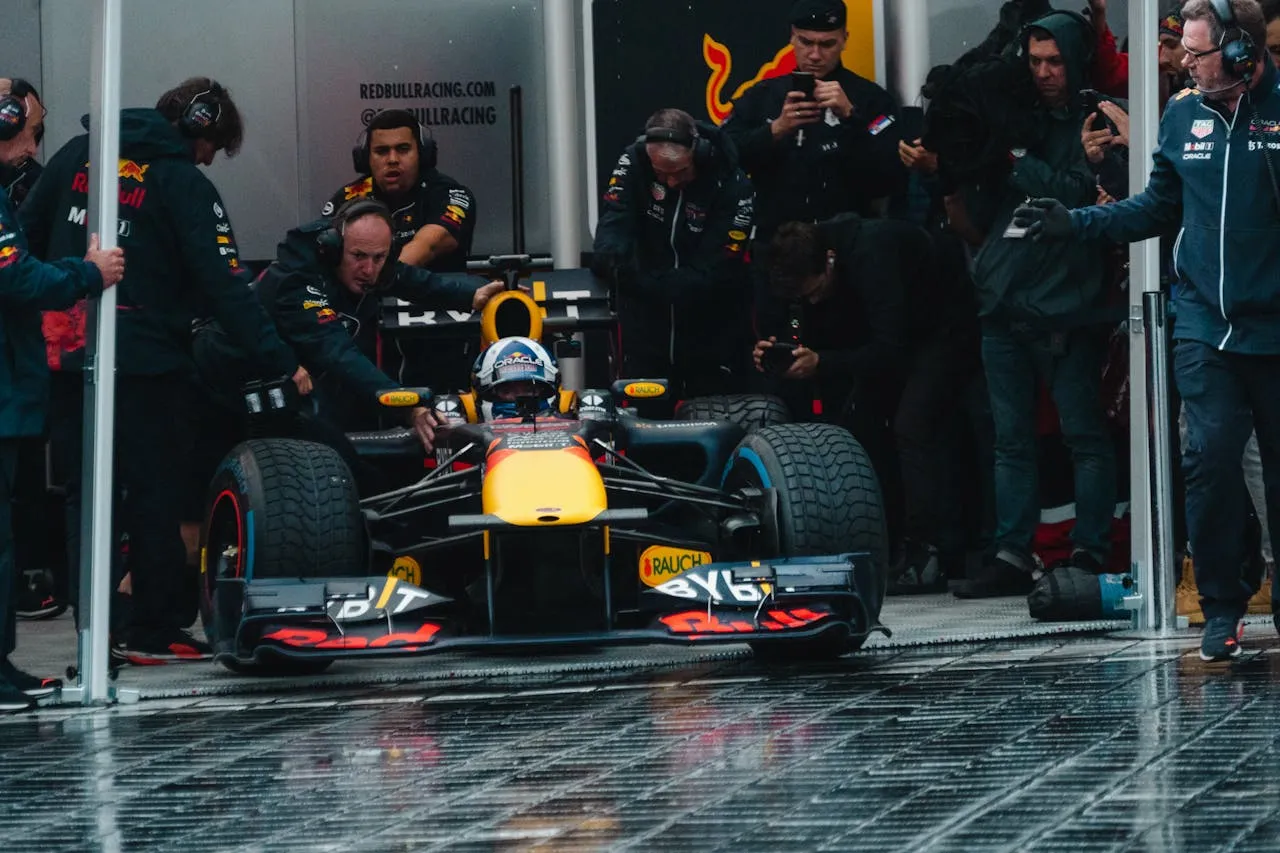
The latest Racing’s Cadillac Formula 1 car renderings signal more than just a new aesthetic direction; they represent a bold technical ambition as the Cadillac Formula 1 Team advances toward its competitive debut on the global stage of Formula 1; beneath the sculpted bodywork and carefully managed aerodynamic surfaces lies one of the most intricate and decisive elements of modern race car performance: the tires; while casual observers may see only round, black rubber mounted at each corner, insiders understand that these components are among the most technologically advanced and strategically vital pieces of machinery on the starting grid; every millisecond gained or lost during a race can often be traced back to how effectively a team comprehends and manages tire behavior under extreme conditions; in the hyper-competitive world of Formula 1, mastery of tire science is not optional but foundational to success
In Formula 1, tires serve as the sole physical connection between a car and the racing surface, transforming theoretical performance into measurable lap times; they transmit braking forces into deceleration, convert aerodynamic downforce into cornering grip, and channel the immense output of hybrid power units into forward motion; without optimal tire performance, even the most advanced chassis and the most powerful engine cannot achieve competitive results; every aspect of a car’s setup—from suspension geometry to weight distribution and aerodynamic balance—ultimately converges at the tire’s contact patch; teams invest vast engineering resources into understanding thermal degradation, compound characteristics, load sensitivity, and pressure evolution because these variables determine how long a tire can sustain peak performance before grip begins to fall away; the complexity lies in the fact that tires must perform consistently under braking zones that generate enormous heat, high-speed corners that impose lateral loads, and acceleration zones that test traction limits; the margin between operating within the ideal performance window and falling outside it can define the outcome of an entire race weekend
Episode 7 of the What Makes Fast docuseries captures this intricate challenge by taking viewers behind the scenes to Milan, Italy, where the exclusive testing facilities of Pirelli operate at the forefront of tire technology; the episode highlights the intersection of engineering intuition and empirical data, revealing how simulation models developed over years must ultimately confront physical validation; the Milan facility, secured and highly confidential, provides each Formula 1 team with a tightly controlled eight-hour session to evaluate the season’s designated tire compounds; this short window represents the culmination of countless hours of virtual modeling, computational analysis, and simulator correlation; for the Cadillac Formula 1 Team, the visit marked a pivotal milestone in its development trajectory, serving as the first opportunity to compare digital predictions with real-world measurements on Pirelli’s advanced test rigs
An eight-hour session may seem substantial, yet in Formula 1 terms it is an extraordinarily compressed timeframe in which critical decisions must be made; engineers must prioritize the most impactful tests, analyze live data streams, and adjust experimental plans in real time; Mario Isola, Motorsport Director at Pirelli, emphasized the intensity of the day, noting that teams must focus sharply on extracting maximum insight from every minute available; there is no margin for hesitation, as each data run contributes to validating—or challenging—months of theoretical assumptions; tire temperature curves, vertical stiffness measurements, and compound response under simulated track loads all feed into a broader understanding of how the car will behave once it reaches an actual Grand Prix circuit; the process demands both analytical rigor and swift decision-making, as teams refine correlation between computational fluid dynamics outputs, driver-in-the-loop simulators, and tangible mechanical behavior observed in Milan
For modern Formula 1 teams, simulation is an indispensable tool; regulations limit physical testing and track time, compelling engineers to rely heavily on virtual environments; over two years of digital development, the Cadillac Formula 1 Team dedicated extensive effort to constructing tire models capable of predicting grip evolution, degradation rates, and interaction with aerodynamic load; these models form the backbone of race strategy simulations, determining optimal pit windows and compound selections; yet no matter how sophisticated, a model remains an abstraction until it is validated by empirical evidence; the Milan test represented the decisive moment when theoretical projections confronted measurable outcomes; would the predicted performance curves align with reality, or would discrepancies reveal hidden assumptions and overlooked variables; the answer would influence not only short-term setup choices but also long-term design refinements across suspension and aero platforms
Guiding the Cadillac Formula 1 Team through this high-stakes evaluation was Heather Bobbitt, Tire Science R&D Leader for GM Motorsports; her role placed her at the intersection of corporate research expertise and competitive racing urgency; Bobbitt and her team entered the Milan facility aware that their preparation would be tested under intense scrutiny; the objective was clear: determine whether their virtual models accurately represented the dynamic characteristics of Pirelli’s compounds; Bobbitt articulated the central question facing the team—whether their projections fell within the expected performance window or diverged significantly from reality; such validation is more than an academic exercise; if correlation proves strong, confidence in development pathways increases; if gaps appear, rapid iteration becomes essential; in either case, the data collected during the eight-hour session would ripple through every subsystem of the car’s design
As a new entrant preparing for its first competitive appearance, the Cadillac Formula 1 Team confronts a steep learning curve; established competitors possess years of historical data correlating tire behavior across diverse circuits; Cadillac, by contrast, must accelerate its understanding to close that experiential gap; the Milan session thus represented more than a routine test—it was a foundational checkpoint in the team’s readiness for race conditions; the ability to interpret tire feedback accurately influences not only performance but also strategic agility; race weekends demand rapid adjustments to weather changes, track evolution, and unexpected safety car deployments; a team confident in its tire modeling can adapt swiftly, optimizing stint lengths and responding to rivals’ strategies; conversely, uncertainty can lead to conservative calls that sacrifice competitive opportunity
Although tires may appear deceptively simple, their internal construction is a symphony of materials engineering; layered compounds, reinforced sidewalls, and carefully engineered tread structures combine to deliver predictable performance under extreme loads; Pirelli’s laboratory rigs replicate braking forces, lateral acceleration, and sustained heat cycles to simulate race conditions with remarkable fidelity; sensors capture deformation patterns, internal temperature gradients, and pressure fluctuations; these metrics feed back into teams’ analytical frameworks, refining predictive algorithms; the complexity arises from the nonlinear nature of tire behavior; grip does not increase or decrease in a straightforward curve but responds dynamically to temperature thresholds and mechanical stress; achieving peak performance requires maintaining the tire within a narrow thermal band, a challenge influenced by ambient conditions, track surface texture, and driving style
With the Milan validation complete, the Cadillac Formula 1 Team moves closer to its inaugural race appearance in the FIA Formula 1 World Championship; anticipation builds as engineering theory transitions into competitive execution; the phrase “where the rubber meets the road” takes on literal significance in this context, encapsulating the moment when preparation yields measurable lap times; the team’s progress through simulation, laboratory validation, and final track deployment reflects the layered complexity of Formula 1 development; each stage narrows uncertainty and sharpens competitive readiness; the ultimate objective is clear: arrive at the grid with a car whose tire behavior aligns predictably with strategic planning and driver expectations
The culmination of tire mastery extends beyond championship circuits; in performance showcases such as Car and Driver’s Lightning Lap 2026, engineering excellence can translate into domination across diverse track challenges; while Lightning Lap differs from Formula 1 competition, the underlying principle remains identical: optimal tire integration unlocks a vehicle’s full dynamic potential; whether on a Grand Prix circuit or during a performance evaluation event, the capacity to harness grip, manage degradation, and sustain peak output defines competitive success; as Cadillac advances toward its Formula 1 debut, the lessons drawn from Milan’s high-security facility and Pirelli’s precision instruments underscore a central truth of motorsport: the simplest-looking components often carry the greatest complexity, and in the relentless pursuit of speed, understanding the science of tires is the key to conquering the track.
Source Link:https://news.gm.com/