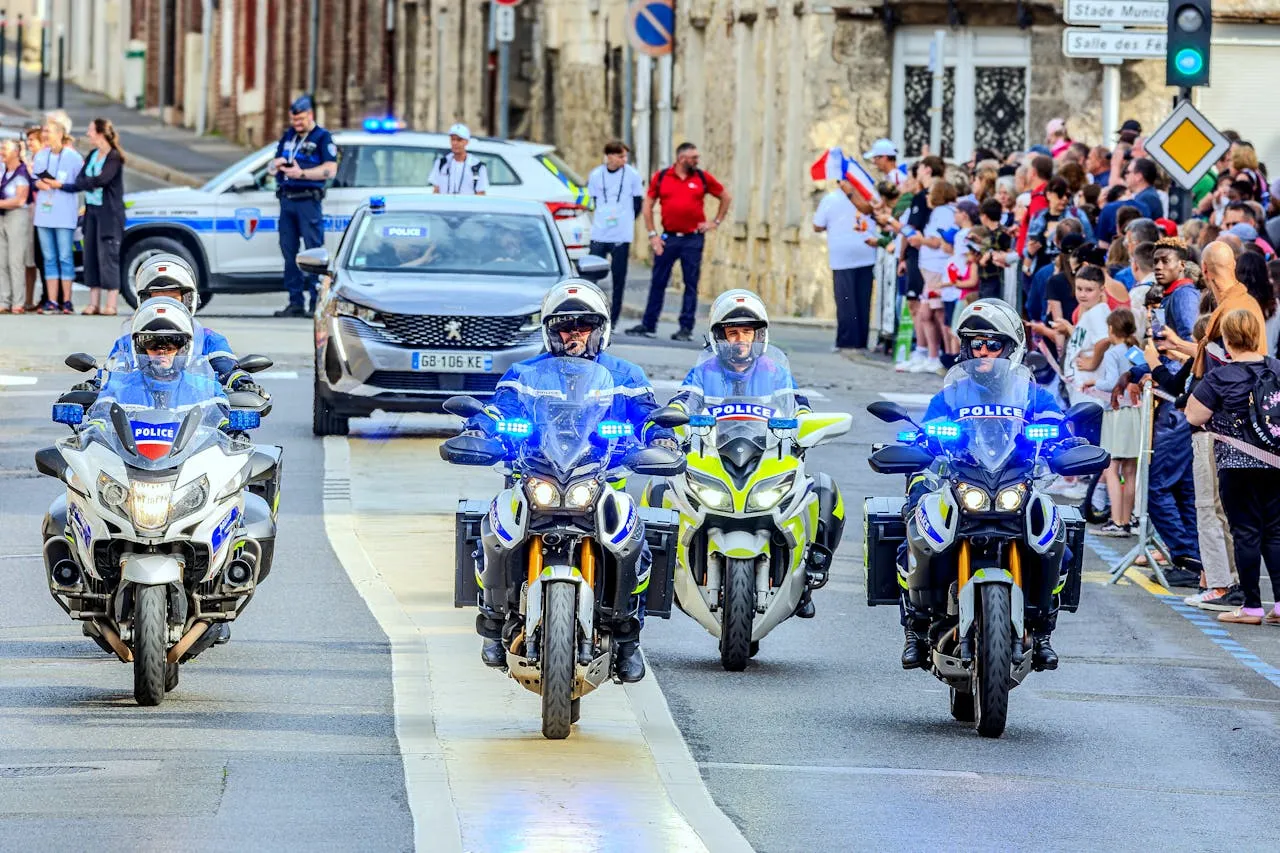
The final message drivers see after a Bahraini police motorcade passes is not another warning or command. Instead, it simply says, “Thank You.” That small gesture is intentional, and it reflects a broader effort by the Kingdom of Bahrain to reshape how official convoys interact with the public on the road.
The Kingdom of Bahrain’s Ministry of Interior has introduced an innovative electronic display system mounted on police escort motorcycles that provides drivers with clear, real-time guidance during official convoy movements. Developed in collaboration with the University of Bahrain, the project represents a modern approach to traffic safety, public communication, and civic cooperation.
For decades, official motorcades around the world have relied largely on flashing lights, sirens, and hand signals to move through traffic quickly and securely. While effective in establishing urgency, those methods can also create confusion for ordinary drivers who may not immediately understand what action they are expected to take. Bahrain’s new system aims to eliminate that uncertainty by replacing ambiguity with direct, visible instructions.
As a convoy approaches, the electronic display system presents a sequence of short, easy-to-read messages that guide motorists step by step. The first message alerts drivers to the presence of an official escort by displaying the word “Police.” This is followed by instructions such as “Slow Down,” encouraging motorists to reduce speed in a controlled and predictable manner.
Depending on traffic conditions, drivers may then see directional instructions such as “Move Right” or “Move Left,” helping them reposition safely and efficiently. If necessary, the system can also display “Stop,” signaling vehicles to pull over and allow the convoy to pass securely.
Once the motorcade has cleared the area, the final message appears: “Thank You.”
That concluding message is central to the philosophy behind the initiative. Rather than treating drivers as obstacles to be managed, the system acknowledges their cooperation and participation in maintaining public safety. Officials say the goal is to transform what can often be a stressful interruption into an interaction built on respect and communication.
The project is being viewed as more than just a technological upgrade. It also reflects a shift in public service culture, where authorities seek to create smoother and more transparent interactions with citizens during routine security operations.
According to Bahraini officials, the idea emerged from a recognition that many drivers become uncertain or anxious when confronted with fast-moving police escorts. In high-pressure traffic situations, hesitation or misunderstanding can increase the risk of accidents, sudden braking, or dangerous lane changes.
By delivering precise instructions in real time, the new system gives drivers immediate clarity about what is expected of them. Authorities believe this improves overall road safety not only for the convoy itself, but also for surrounding civilian traffic.
The project required approximately eighteen months of research, design, testing, and refinement before reaching operational deployment. Engineers and designers focused heavily on ensuring the system would function reliably under Bahrain’s demanding environmental conditions.
One of the biggest challenges was visibility. Bahrain’s climate includes extremely bright sunlight and intense summer heat, conditions that can make ordinary digital screens difficult to read. To address this issue, developers created custom-built 16-inch high-brightness electronic displays specifically designed for outdoor operational use.
The displays were engineered to remain clearly visible even under direct sunlight during peak daytime conditions. A dedicated cooling system was integrated into the rear housing of the motorcycles to prevent overheating and ensure stable performance during long deployments in high temperatures.
Durability and aerodynamics were also major considerations during development. Since the display units are mounted on escort motorcycles traveling at high speeds, the system had to remain stable without negatively affecting handling or rider safety.
To achieve this, the display casings were built using lightweight aluminum frames and underwent multiple aerodynamic evaluations. Engineers refined the shape and structure repeatedly to reduce drag and maintain balance while minimizing additional weight on the motorcycles.
Another key design priority was operational simplicity for police riders. During convoy operations, riders must focus on traffic conditions, positioning, and coordination with other escort units. Introducing complicated controls could create unnecessary distraction.
To solve this issue, developers equipped the motorcycles with a forward-facing mirror display that allows riders to instantly see exactly what message is being shown to traffic behind them. This helps eliminate the possibility of incorrect messaging or display errors during live operations.
The motorcycles also feature illuminated control panels that can be operated safely while riding, enabling officers to change messages quickly and efficiently as traffic conditions evolve.
Beyond the hardware itself, significant attention was devoted to the design of the visual messaging. The graphics and communication layout were created by the Public Relations Department at the University of Bahrain.
Officials wanted to ensure that the instructions would be instantly understandable to a broad cross-section of drivers. To evaluate clarity and public response, the university conducted a survey involving approximately 1,000 students. Feedback from that research helped refine the wording, appearance, and readability of the messages before final implementation.
The collaboration between the Ministry of Interior and the University of Bahrain highlights the growing role academic institutions are playing in applied public-sector innovation. Rather than outsourcing the concept internationally, Bahrain developed the system domestically through local engineering, design, and operational expertise.
The Ministry of Interior’s Transport Directorate supervised the fabrication process, installation, and extensive field testing on active roads. Officials say real-world testing was critical to ensuring the system could perform effectively in live traffic scenarios involving varying speeds, weather conditions, and road environments.
Major General Abdulrahman Al Khalifa, Director General of Traffic Police, emphasized that the initiative was created in response to practical road safety concerns.
He explained that drivers often face moments of sudden uncertainty when an official convoy approaches, particularly in busy urban traffic. The new display system, he said, is designed to remove confusion by providing immediate, simple, and highly visible instructions.
According to Major General Al Khalifa, road safety depends on shared responsibility among all road users. He noted that awareness, cooperation, and mutual respect are essential to maintaining safe and orderly traffic conditions, particularly during official movements.
Officials believe the initiative also contributes to reducing driver stress. Sudden sirens and rapidly approaching escorts can create panic reactions among motorists unfamiliar with convoy procedures. Clear messaging allows drivers to respond more calmly and predictably, potentially lowering the risk of collisions or erratic maneuvers.
The system aligns with Bahrain’s broader national strategy of modernizing public infrastructure through technology-driven solutions. Over recent years, the Kingdom has increasingly invested in smart systems across transportation, security, and urban services as part of wider quality-of-life initiatives.
Traffic management has become a major focus area for many governments worldwide as urban populations grow and road networks become more congested. Bahrain’s approach demonstrates how relatively simple communication technology can improve coordination between authorities and the public without requiring major infrastructure expansion.
The project has also drawn attention for its human-centered approach. While the technology itself is advanced, the underlying concept is built around communication and courtesy rather than enforcement alone.
The decision to conclude every interaction with a “Thank You” message has become one of the system’s most widely discussed features. Officials say that acknowledgment reinforces the idea that drivers are active participants in public safety rather than passive subjects of traffic control.
In many ways, the message serves as a symbolic gesture that reflects Bahrain’s efforts to foster a more cooperative relationship between public institutions and the community.
As the system continues operating on Bahraini roads, authorities are expected to monitor driver response, operational effectiveness, and potential future enhancements. Additional features or expanded deployment could emerge as the technology evolves and operational data is collected.
For now, the initiative stands as an example of how innovation in public safety does not always require large-scale disruption or complex artificial intelligence systems. Sometimes, a clearer message — combined with respect for the public — can make a meaningful difference.
By integrating technology, engineering, communication design, and civic awareness into a single operational platform, Bahrain has introduced a motorcade guidance system that prioritizes both safety and human interaction.
Source Link:https://www.businesswire.com/