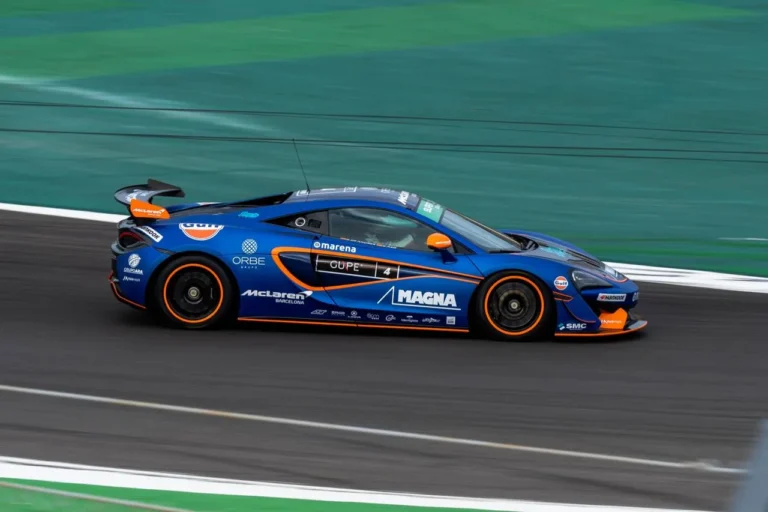
For most drivers, an engine’s toughest day might involve a long highway journey, towing a trailer up a steep grade, or navigating heavy traffic on a hot summer afternoon. For Ford engineers, however, the path to creating a durable engine often begins in conditions far more extreme than anything a typical street vehicle will ever experience.
Ford’s approach to powertrain durability is built around a simple but demanding philosophy: push engines and transmissions to their limits, identify weaknesses before customers do, and use those discoveries to create stronger production vehicles.
One of the clearest examples of this philosophy can be found in Ford’s 5.0-liter V8 family, including the Coyote V8 used in vehicles such as the Mustang and F-150. Before improvements reach production vehicles, similar engine designs can be subjected to the punishing conditions of motorsports, where wide-open throttle, extreme heat, high engine speeds, intense vibration and long periods of continuous operation expose components to stresses that are difficult to replicate anywhere else.
Race engines are built to perform at the highest possible level. They are expected to deliver enormous power while operating for extended periods under conditions that leave little margin for weakness. When something fails, engineers do not simply see a broken component. They see valuable information.
That information can lead to changes in materials, component design, cooling systems, lubrication strategies or manufacturing processes. In some cases, a problem discovered during racing can lead to a production improvement that benefits customers who may never visit a racetrack.
Ford’s racing programs provide engineers with an environment where powertrains can be pushed far beyond normal road use. Engines operate under extreme loads, and teams collect extensive data through real-time telemetry systems.
Engineers can monitor a wide range of information while an engine is operating, including temperatures, pressures, vibration levels, rotational speeds and other performance characteristics. When a component begins to behave differently from expectations, the data can help engineers understand what is happening and why.
This type of testing is particularly valuable because modern engines are complex systems. A component failure may not be caused by a single design flaw. It may result from the interaction of heat, vibration, pressure, lubrication and repeated stress over time.
The goal is therefore not simply to repair a failed part. Engineers want to understand the conditions that caused the failure and determine whether the design can be improved.
Ford 5.0-liter V8-based race engines have been pushed to levels of performance and endurance that no ordinary street car would normally experience. That extreme testing revealed opportunities to improve areas such as the camshaft drive system.
The lessons learned through racing helped engineers refine the design and apply improvements to the production 5.0-liter Coyote V8 engine.
This is an important part of Ford’s broader engineering strategy. Racing is not separated from production vehicle development. Instead, it can serve as a high-intensity proving ground where new ideas and existing designs are exposed to the harshest possible operating conditions.
Traditional thinking might suggest that a successful engineering program is one in which nothing breaks. Ford engineers take a different view during internal testing.
Charles Poon, Ford vice president of Vehicle Hardware and Software Engineering, along with the Powertrain Engineering team, has described the importance of looking at failures differently.
According to this philosophy, internal test failures can be valuable because they reveal weaknesses before a vehicle reaches a customer.
“The more issues we identify during testing, the lower the chance of our customers experiencing them,” Poon said.
That approach changes the meaning of failure. A component that breaks during a controlled test has not necessarily represented a failure of the overall development process. Instead, it may have provided engineers with an opportunity to improve the design.
The objective is to discover weaknesses in a controlled environment, where engineers can analyze the failure, redesign the component and test the solution again.
This process can involve repeatedly pushing a powertrain to its limits. Engines may be run for long periods, subjected to extreme temperatures and exposed to repeated cycles of high load. Transmissions can be tested under demanding conditions designed to simulate years of hard use.
The process is intentionally aggressive because the objective is to identify potential problems before the vehicle enters the hands of customers.
The development process depends heavily on cooperation between two distinct groups within Ford.
On one side are Ford Racing engineers, technicians and pit crews. Their work often involves continuous monitoring of race vehicles, analyzing telemetry and responding to problems in real time. Their engines can experience hours of high-speed operation, wide-open throttle, extreme heat and intense vibration.
The racing environment produces data that is difficult to generate in conventional road testing. Every lap can provide new information about how an engine performs under stress.
On the other side are Ford Product Development engineers. These teams study the information generated through racing and other durability tests. When a potential weakness is identified, they work to develop solutions that can improve the design.
The cooperation between the racing and production engineering teams allows lessons from motorsports to move into the vehicle development process.
This relationship is especially important when the same basic engine architecture is used across different applications. An engine that powers a high-performance sports car may also share fundamental engineering principles with a truck engine designed for towing and daily use.
The operating conditions may be different, but the lessons learned about durability, heat management and component strength can be valuable across the product range.
Testing does not end when an engine comes off the racetrack. After engines have completed demanding testing cycles, they can be sent to facilities such as the Essex Engine Plant for detailed examination.
There, experienced mechanics and engineers tear down engines to inspect their internal components.
The purpose of this process is to look for signs of wear, stress or potential weakness. Engineers examine components that may appear to be functioning normally but could reveal valuable information after operating under extreme conditions.
A detailed teardown can help answer important questions. Did a component experience unusual wear? Was a particular part exposed to more heat than expected? Did vibration affect the durability of a system? Did a component perform better or worse than engineering models predicted?
These answers can help Ford refine its understanding of how powertrains behave in real-world conditions.
The findings can then be used to improve future designs.
In some cases, the result is a major redesign. In other cases, a relatively small improvement can make a significant difference in long-term durability.
The camshaft drive upgrade associated with Ford’s 5.0-liter V8 is an example of how lessons learned from extreme testing can create opportunities for production improvements.
Without the intense demands of racing and durability testing, engineers may not have identified the same opportunity or developed the same solution for retail vehicles.
The ultimate purpose of this testing is not simply to build engines capable of winning races. The goal is to deliver vehicles that customers can depend on.
A Ford F-150 owner may use a truck to tow heavy equipment to a job site. A Mustang GT driver may spend most of the time commuting or traveling on highways. A Mustang Dark Horse owner may take the car to a racetrack to explore its performance capabilities.
Each vehicle has a different mission, but all benefit from careful engineering and durability testing.
The extreme conditions experienced by a race engine can help engineers identify opportunities to make production engines stronger and more reliable. Those improvements can then benefit customers in everyday situations.
A truck towing a heavy load up a steep incline can place significant demands on its powertrain. A sports car operating at high speed can generate substantial heat and stress. Even a daily-driven vehicle experiences repeated cycles of acceleration, braking and temperature changes over its lifetime.
The more engineers understand about how components respond to extreme conditions, the better they can design them for long-term use.
Ford’s engineering philosophy extends beyond simply finding defects. A key objective is to predict how and when a failure might occur.
Poon has emphasized that testing is ultimately about validating engineering models and ensuring that predictions align with real-world behavior.
“When a failure does occur, our goal is to predict exactly what will fail and when,” he said. “That level of predictability is how we prove our engineering models truly align with real-world conditions.”
This approach is important because modern powertrain development relies heavily on computer modeling and simulation.
Engineers use models to predict how components will perform under different loads and conditions. Physical testing then provides an opportunity to compare those predictions with actual results.
When the model and the real-world test agree, engineers gain confidence in the design. When they do not, the difference provides an opportunity to improve both the component and the engineering model.
That process can make future development more efficient and more accurate.
The development of a durable powertrain is never truly finished.
Even after an engine or transmission enters production, engineers continue to study performance, durability and test results. New testing methods can reveal opportunities that were not previously visible. Advances in data analysis can also help teams identify patterns in information collected from racing and laboratory testing.
The objective is continuous improvement.
Ford’s approach demonstrates how motorsports can contribute to the development of vehicles used far beyond the racetrack. The extreme environment of racing provides engineers with a demanding test bed, while production development teams transform lessons from that environment into improvements for everyday vehicles.
The result is a development cycle in which failures are not simply setbacks. They are opportunities to understand how a powertrain behaves under stress and to make it stronger.
For Ford customers, that work can translate into greater confidence in the vehicles they drive, whether they are towing a heavy trailer with an F-150, cruising in a Mustang GT or exploring the performance capabilities of a Mustang Dark Horse.
The engines may be tested at the limits of performance, but the benefits ultimately reach drivers in the real world.
From race tracks and test laboratories to engine plants and production vehicles, Ford’s durability strategy is built around one central idea: find the weaknesses first, learn from them and improve the product before customers ever have the chance to experience the problem.
And as Ford continues developing its engines and transmissions, the search for new ways to strengthen its powertrains continues. The next breakthrough may begin with another extreme test, another unexpected failure or another component pushed beyond its intended limits.
Source Link:https://www.fromtheroad.ford.com/