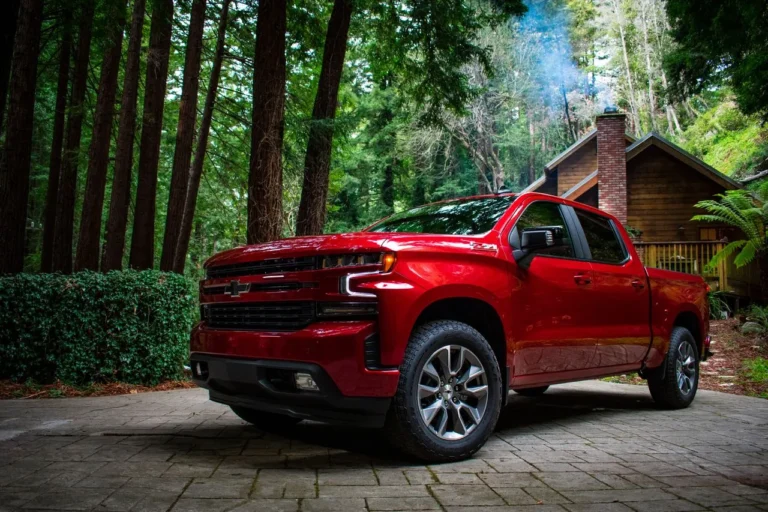
General Motors is taking its iconic Small Block V8 engine architecture into a new generation with two newly developed engines designed for the company’s next-generation light-duty pickup trucks. The new 5.7-liter L76 and 6.6-liter L78 V8 engines will power the 2027 Chevrolet Silverado 1500 and GMC Sierra 1500, delivering increased horsepower, torque and capability while incorporating updated technologies aimed at improving efficiency, durability and everyday drivability.
The new engines represent the latest evolution of GM’s sixth-generation Small Block architecture, an engine family with roots stretching back decades. By increasing displacement and introducing new combustion, airflow, lubrication and fuel-system technologies, GM engineers have developed V8 powertrains intended to meet the demanding requirements of modern full-size pickup customers.
The introduction also expands GM’s latest Small Block family beyond the recently announced 6.7-liter LS6 V8 developed for the 2027 Chevrolet Corvette Stingray, Grand Sport and Grand Sport X. Together, these engines demonstrate GM’s continued investment in naturally aspirated V8 technology across both performance cars and full-size trucks.
GM’s Small Block V8 is one of the company’s most recognizable engine architectures. Since its introduction in 1955, more than 100 million Small Block engines have been produced, with the basic architecture evolving across generations and applications.
For the next-generation light-duty pickup lineup, GM has returned to two familiar displacement figures. The new L76 measures 5.7 liters, equivalent to 350 cubic inches, while the L78 increases displacement to 6.6 liters, or 400 cubic inches.
The larger displacements are achieved primarily through an increase in piston stroke. GM engineers increased the stroke by 6 millimeters compared with the previous 5.3-liter and 6.2-liter engines. The additional displacement provides a foundation for producing greater torque and horsepower while maintaining the fundamental architecture associated with GM’s Small Block family.
Both engines retain the 4.40-inch cylinder bore-center spacing that has been a defining feature of the Small Block architecture for generations.
GM says the latest engines were developed using advanced modeling and simulation technologies combined with extensive hardware testing. This development approach allowed engineers to evaluate performance, durability and efficiency before moving into large-scale production and real-world validation.
The new 5.7-liter L76 V8 produces 402 horsepower and 428 pound-feet of torque. The engine is designed to provide a balance of performance and everyday usability for customers who use their trucks for towing, hauling, commuting and recreational driving.
The larger 6.6-liter L78 takes output even further, producing 481 horsepower and 501 pound-feet of torque. According to GM, the 6.6-liter is the most powerful naturally aspirated V8 in its class.
The increase in displacement is only one part of the performance strategy. GM engineers also raised the compression ratio to improve combustion efficiency and introduced larger throttle diameters to allow more air into the engine.
New intake manifolds with tuned runners have also been developed to manage the increased airflow. These changes are designed to help the engines generate their higher output while maintaining the drivability expected from a modern full-size pickup.
The increased engine performance also supports the towing capability of GM’s truck portfolio. Chevrolet says the Silverado 1500 can achieve a maximum available tow rating of 13,700 pounds when properly equipped.
Although the new engines maintain the naturally aspirated V8 configuration, they incorporate modern technologies designed to improve combustion, emissions performance and operating efficiency.
One of the most significant developments is a dual-fuel injection system combining direct injection and port fuel injection.
The system gives engineers greater flexibility in managing fuel delivery across different engine operating conditions. Direct injection can support precise fuel delivery and combustion control, while port fuel injection provides another method for optimizing operation in different power, efficiency and emissions conditions.
GM says the dual-fuel approach allows the engines to operate across broader optimal power, efficiency and emissions windows.
This technology represents an important evolution of the traditional Small Block V8. Rather than relying solely on increased displacement to generate performance, the new engines combine displacement with modern fuel and combustion-management systems.
Durability is another major focus of the sixth-generation Small Block architecture.
The new L76 and L78 engines feature an updated lubrication system incorporating a continuously variable oil pump, an on-engine oil cooler and revised oil-feed locations.
The continuously variable oil pump allows oil delivery to be managed according to operating conditions. Rather than maintaining a single fixed pumping strategy across the engine’s operating range, the system can adjust oil delivery to support lubrication requirements.
The revised oil-feed locations are designed to improve oil-pressure consistency throughout engine operation, while the integrated oil cooler helps manage lubricant temperatures during demanding conditions.
These technologies are particularly relevant to pickup trucks because their engines can spend extended periods under heavy loads. Towing trailers, carrying heavy payloads and driving in demanding terrain can place additional thermal and mechanical demands on a powertrain.
GM’s development program is intended to ensure that the new V8s can withstand those everyday requirements.
Before the 2027 Chevrolet Silverado 1500 and GMC Sierra 1500 reach dealerships, GM development teams expect to complete more than 1.5 million miles, or approximately 2.4 million kilometers, of real-world on-road validation.
The testing program is designed to evaluate the engines under a wide range of conditions and usage scenarios.
For full-size pickup customers, engine durability can be particularly important because trucks frequently serve multiple purposes. The same vehicle may be used for daily commuting during the week, towing on weekends and off-road driving during recreational activities.
GM says the new V8s were developed around these everyday demands, with testing intended to provide confidence across towing, hauling, commuting and off-road applications.
The extensive validation program also reflects the company’s continued emphasis on durability as it introduces a new generation of its long-running Small Block architecture.
The new V8 engines will not be the only powertrains available in the next-generation Silverado 1500 and Sierra 1500.
GM is also enhancing its TurboMax engine. The updated engine gains 40 horsepower and 25 pound-feet of torque, giving it improved performance and drivability.
The TurboMax updates include a new turbocharger, an upgraded fuel-injection system, improved active thermal management and redesigned pistons.
The engine will also be paired with a 10-speed automatic transmission. GM says the combination is designed to provide smoother shifting, stronger power delivery and improved towing performance.
The TurboMax provides an alternative to the naturally aspirated V8 configuration for customers who prioritize turbocharged performance and efficiency characteristics.
GM is also retaining its 3.0-liter Duramax Turbo-Diesel as part of the 2027 light-duty pickup powertrain lineup.
The diesel produces 305 horsepower and 495 pound-feet of torque, giving it strong low-end torque characteristics suited to towing and long-distance driving.
The Duramax is designed to provide quiet and smooth operation while maintaining the torque characteristics expected from a diesel engine.
GM has made several updates to the diesel powertrain for the next generation. These include revised diesel exhaust fluid level indicators along with changes involving the piston, turbo vane, next-generation NOx sensor, sealing systems and fuel-injector corrosion protection.
The updates are intended to support performance, reliability and long-term customer confidence.
All engines in GM’s 2027 light-duty truck powertrain portfolio will be paired with a 10-speed automatic transmission.
The transmission provides a broad range of gear ratios designed to balance acceleration, highway cruising and towing requirements.
For customers who regularly tow trailers or carry heavy loads, transmission behavior is particularly important. Gear selection, shift timing and power delivery can directly influence how easily a truck manages changes in grade and load.
GM’s decision to pair its next-generation engines with the 10-speed automatic transmission provides a common transmission strategy across the powertrain lineup.
The combination of the engines and transmission is intended to provide smooth everyday driving while also supporting the capability expected from full-size pickups.
GM is also offering a new 34-gallon, or 129-liter, fuel tank for the 5.7-liter and 6.6-liter V8 engines.
The larger tank can reduce the frequency of fuel stops for customers who travel long distances, tow trailers or use their trucks for extended road trips.
When the 34-gallon tank is combined with the 3.0-liter Duramax Turbo-Diesel, GM says the truck can offer a highway driving range of more than 900 miles.
For customers who use full-size pickups for long-distance travel, towing or commercial applications, extended driving range can be an important practical consideration.
The development of the sixth-generation Small Block is also tied to significant investments in GM’s North American manufacturing operations.
Production of the new 5.7-liter and 6.6-liter V8 engines will involve teams at GM’s Flint Engine Operations, Tonawanda Propulsion and St. Catharines Propulsion plants.
GM has previously announced major manufacturing investments to support the next generation of trucks and V8 engines. The company has outlined approximately $9 billion in U.S. manufacturing investment, including $888 million at Tonawanda Propulsion in New York for sixth-generation V8 production for full-size trucks and SUVs.
In Canada, GM is investing C$691 million at St. Catharines Propulsion to support production of sixth-generation V8 engines.
The company has also announced investments in other facilities supporting truck manufacturing and 10-speed transmission production.
These investments demonstrate that the launch of the new engines involves more than the development of a new powertrain. It also requires manufacturing capacity, tooling, production technology and workforce capabilities capable of supporting the next generation of GM’s full-size truck business.
The latest engines also highlight how GM has adapted the Small Block architecture across a wide range of applications.
Over the decades, Small Block engines have been used in production vehicles, motorsports, marine propulsion and performance applications. GM’s broader ecosystem includes GM Powered Solutions, which applies Small Block engineering to marine applications, as well as Chevrolet Performance, which offers Small Block, LS, LT and racing crate engines.
The new sixth-generation architecture therefore builds on an engine family that extends well beyond conventional passenger vehicles.
The return of the 350- and 400-cubic-inch displacement figures also connects the latest technology with familiar Small Block history. At the same time, the new engines incorporate modern fuel injection, airflow management, lubrication technology, thermal management and manufacturing processes.
The 2027 Chevrolet Silverado 1500 and GMC Sierra 1500 represent the next stage of GM’s full-size light-duty pickup strategy, and the new V8 engines are central to that transition.
The 5.7-liter L76 combines 402 horsepower with 428 pound-feet of torque, while the 6.6-liter L78 produces 481 horsepower and 501 pound-feet of torque. Both engines use increased displacement, higher compression, improved airflow and advanced fuel-system technology to deliver their performance.
At the same time, GM is maintaining customer choice through its updated TurboMax and 3.0-liter Duramax Turbo-Diesel powertrains.
The result is a powertrain portfolio that covers different customer requirements, from naturally aspirated V8 performance to turbocharged operation and diesel torque.
The new V8 engines are scheduled to become available with the launch of the next-generation Chevrolet Silverado 1500 and GMC Sierra 1500 later in 2026. GM says additional information, including pricing and detailed vehicle specifications, will be announced in future updates.
With the sixth-generation Small Block architecture, GM is combining a long-established engine design with modern engineering and manufacturing technologies. For full-size pickup customers, the new engines are designed to deliver higher output, towing capability, durability and everyday usability while continuing the company’s long-running V8 tradition.
Source Link:https://news.gm.com/