For most people, energy is something they rarely think about. It is simply there when they switch on a light, charge a device, heat a building or start a vehicle. Transportation is often taken for granted as well, until a road closes, a vehicle breaks down or an essential connection between communities is disrupted.
For Taylor Searcy, however, energy and transportation are much more than everyday conveniences. They are interconnected systems that influence communities, businesses and the environment.
Searcy’s career has given him a unique perspective on how important reliable infrastructure can be. Before joining General Motors, he served as a Surface Warfare Officer in the U.S. Navy aboard the USS Lassen. His military experience placed him in situations where careful planning, teamwork, leadership and constant awareness were essential.
Today, those same principles guide his work as Clean Energy Strategy Lead at GM. Instead of helping navigate a naval destroyer, Searcy now focuses on the energy systems that support GM’s manufacturing facilities, technology centers and offices.
His journey from military service to corporate sustainability demonstrates how skills developed in one demanding environment can become valuable tools for tackling some of the challenges facing the automotive industry.
As Officer of the Deck aboard the USS Lassen, Searcy was responsible for helping safely navigate a billion-dollar guided-missile destroyer and its crew of more than 300 sailors.
The position required far more than simply monitoring the ship’s surroundings. It demanded constant situational awareness, communication and judgment. Decisions had to be made with an understanding of how individual actions could affect the entire operation.
The experience taught Searcy an important lesson about leadership: responsibility does not mean attempting to make every decision independently.
Instead, effective leadership involves understanding one’s authority, recognizing the expertise of others and knowing when an issue should be escalated through the appropriate chain of command.
That lesson has remained relevant throughout his professional career.
Large organizations, like naval vessels, depend on many people and systems working together. No individual can manage every component alone. Successful outcomes require collaboration and the ability to involve the right people at the right time.
For Searcy, this approach continues to influence how he handles complex challenges at GM.
Military service also taught Searcy the importance of preparing for uncertainty.
In the Navy, having a plan was essential, but circumstances could change quickly. Weather, operational requirements, equipment conditions and other unexpected developments could force personnel to adjust their approach.
As a result, planning often meant developing multiple courses of action rather than relying on a single expected outcome.
That mindset has translated directly into Searcy’s work in clean energy strategy.
Energy planning involves numerous variables. Costs can change, demand can fluctuate, infrastructure requirements can evolve and new technologies can alter the available options. Companies must therefore consider both current needs and future possibilities.
Searcy’s Navy experience taught him to build flexibility into a plan from the beginning.
Rather than assuming that everything will happen exactly as expected, he approaches challenges with contingencies in mind. This allows teams to respond more effectively when conditions change while remaining focused on the broader objective.
One of the experiences that most influenced Searcy’s understanding of energy happened during one of his first port visits aboard the USS Lassen.
The ship traveled to Dili, the capital of Timor-Leste, a Southeast Asian country located north of Australia.
During the visit, Searcy observed regular nighttime power outages. At the time, Timor-Leste was still dealing with the long-term consequences of its struggle for independence, and its electrical infrastructure remained limited.
The experience made Searcy reconsider something that many people rarely question: access to dependable energy.
In countries with established electrical grids, people can easily assume that electricity will always be available. Lights come on with the flip of a switch, businesses operate throughout the day and technology remains connected.
But seeing regular blackouts demonstrated that energy reliability is not guaranteed everywhere.
For Searcy, the experience helped transform energy from an abstract concept into something directly connected to people’s daily lives.
Reliable electricity affects homes, businesses, schools, transportation and essential services. When power is unavailable, the impact can extend far beyond a dark room.
That experience remained with him and eventually influenced his professional interest in sustainability and energy systems.
Searcy had already developed an interest in sustainability before leaving the Navy, but his military experiences gave that interest greater urgency.
His time at sea exposed him to the enormous logistical requirements associated with operating ships over long distances. Fuel, supplies, equipment and other resources all had to be carefully managed.
He also encountered communities where environmental resources were limited or had been heavily exploited.
Another formative experience came when Searcy researched sustainable maritime transportation in Fiji.
Remote island communities often depended on infrequent maritime connections to obtain goods and services. When ships were unreliable or unavailable, communities could become isolated from the mainland and from essential resources.
These experiences helped Searcy understand the relationship between transportation, energy, economic opportunity and environmental sustainability.
The issues were not separate.
Transportation requires energy, energy systems affect communities, and environmental conditions influence how resources can be produced and delivered.
That interconnectedness became an important part of Searcy’s professional perspective.
After completing his active-duty military service, Searcy wanted to continue working on challenges that could have a positive impact on people and the environment.
His next steps included pursuing a dual master’s degree program in Japan and Germany.
His education and international experiences expanded his understanding of sustainability and transportation beyond the military environment.
He later worked with a small team in the South Pacific focused on sustainable maritime transportation. The work allowed him to explore how transportation systems could become more resilient and environmentally responsible.
For Searcy, clean energy represented a natural continuation of the questions he had encountered throughout his career.
How can essential systems remain reliable?
How can communities gain better access to transportation and energy?
How can organizations reduce environmental impact without compromising affordability and performance?
These questions eventually led him to General Motors.
At GM, Searcy works on the energy required to support the company’s large-scale operations.
Automotive manufacturing is highly energy intensive. Vehicle assembly plants, design centers, technology facilities and offices all require dependable electricity and other forms of energy to operate.
For an automaker, energy strategy therefore has to balance several priorities.
Reliability is essential because manufacturing operations depend on consistent power. Cost is another important consideration because energy represents a significant operational expense. At the same time, companies are under increasing pressure to reduce emissions and transition toward cleaner energy sources.
Searcy’s role sits at the intersection of these priorities.
His work focuses on helping GM advance cleaner energy systems while considering cost and reliability.
That balance is particularly important as the automotive industry undergoes a broader transformation.
Automakers are investing heavily in electric vehicles, battery technology, renewable energy and new manufacturing processes. The transition to electrification is not limited to the vehicles themselves. It also involves examining how those vehicles are manufactured and how the energy supporting the entire ecosystem is generated.
Searcy points to GM’s renewable-energy progress as an important part of that broader transition.
The company reported that it secured enough renewable energy to match 100% of its U.S. electricity use in 2025, making GM the first U.S. automaker to reach that milestone.
For Searcy, the achievement represents more than a corporate sustainability target.
It demonstrates how energy strategy can become part of a larger transformation across the automotive industry.
Manufacturing vehicles requires significant amounts of energy, meaning that reducing the environmental impact of production can complement efforts to develop lower-emission vehicles.
The transition therefore involves looking at the entire lifecycle of mobility, from manufacturing and energy sourcing to vehicle use.
Searcy also sees electric vehicles as more than simply an alternative to gasoline-powered transportation.
As EV technology develops, vehicles can become increasingly connected to the broader energy system.
One example is bidirectional charging.
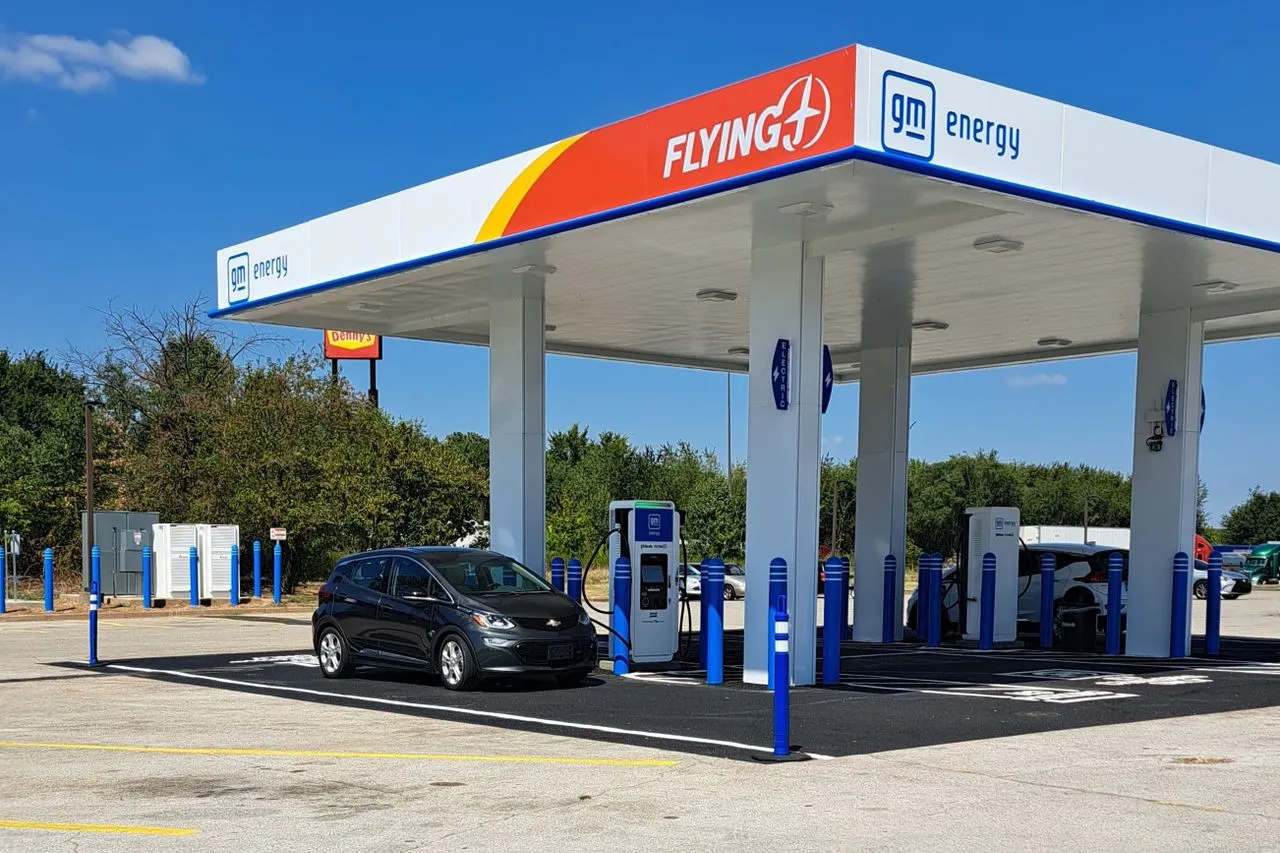
With compatible technology, an electric vehicle can potentially supply electricity back to a home during an outage, effectively allowing the vehicle’s battery to serve as a backup energy source.
This changes the traditional relationship between vehicles and electricity.
Instead of being purely consumers of energy, EVs can potentially become part of a more flexible energy ecosystem.
For Searcy, this connection between transportation and energy makes his work at GM especially meaningful.
The same industry that produces vehicles is also participating in a changing energy landscape.
Searcy’s career demonstrates that military experience can translate into a wide range of civilian and corporate roles.
The skills he developed in the Navy — planning, leadership, communication, risk awareness and decision-making — are applicable to complex business environments.
One particularly valuable skill is understanding how different systems interact.
A naval vessel is a highly interconnected organization. People, equipment, communications, navigation and logistics must function together.
Modern energy systems have similar characteristics.
Power generation, transmission, consumption, storage, infrastructure and technology are all connected. Changes in one area can influence another.
Searcy’s experience allows him to approach these challenges with an appreciation for both individual components and the larger system.
Searcy believes veterans should recognize the value of the skills they already possess when considering careers after military service.
Clean energy and sustainability are broad fields, and professionals can enter them through many different paths.
Veterans bring experience dealing with responsibility, uncertainty, teamwork and high-pressure situations. They also understand the importance of contributing to something larger than themselves.
Those capabilities can be valuable across industries, including automotive manufacturing, technology, energy, logistics and sustainability.
Searcy also encourages veterans to make use of their networks.
Connecting with other veterans, asking questions and exploring different career paths can help identify opportunities that may not be immediately obvious.
There is no single formula for transitioning from military service into a civilian career.
For Searcy, the connection between his Navy experience and his work at GM is ultimately grounded in integrity.
At the U.S. Naval Academy, he was influenced by the Navy’s core values of honor, courage and commitment.
At GM, the principle of “Win with Integrity” resonates with that foundation.
Although the environment and mission may change, the underlying values can remain consistent.
Taylor Searcy’s journey from the deck of a Navy destroyer to clean energy strategy at one of the world’s largest automakers illustrates how professional missions can evolve without losing their sense of purpose.
His military career taught him the importance of responsibility, preparation and teamwork. His international experiences showed him how deeply communities depend on reliable energy and transportation. His academic and professional work helped transform those observations into a career focused on sustainability.
At GM, those experiences now contribute to the company’s efforts to navigate an increasingly complex energy and automotive landscape.
The transition from military service to clean energy may appear, at first, to be an unexpected career path. For Searcy, however, the connection is clear.
Both require people to think beyond individual decisions, prepare for uncertainty and understand how interconnected systems affect the people who depend on them.
Whether navigating a naval destroyer or helping shape an automaker’s energy strategy, the mission remains rooted in the same fundamental idea: reliable systems, responsible decisions and committed teams can create meaningful impact.
Searcy’s story is ultimately a reminder that a career does not have to follow a straight line to have a clear purpose. The lessons learned in one mission can become the foundation for another — and sometimes, those experiences can help shape a more sustainable future.
Source Link:https://news.gm.com/