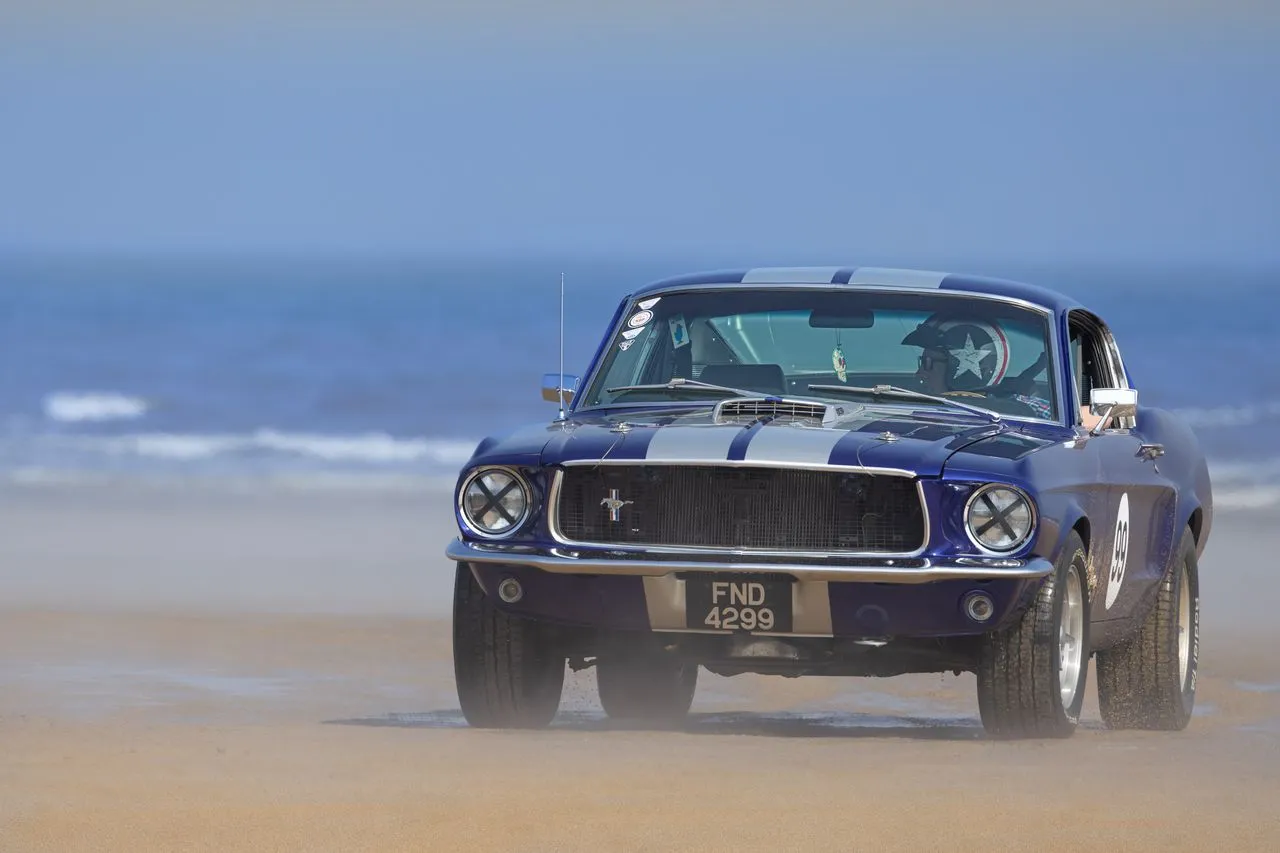
Growing up in Metro Detroit, I heard stories about this Mustang long before I ever had the chance to see it in person.
It was the kind of car that seemed to exist somewhere between automotive history and legend. You would hear about it from another enthusiast, a former engineer, or someone who claimed to know somebody who had worked on it. One person had supposedly seen it years earlier. Another had an old photograph. Someone else knew an engineer who had been involved with the project.
The details always sounded almost too extraordinary to be true.
A Mustang coupe powered by a V10 engine.
A secret project.
A one-of-one prototype.
For anyone who grew up around cars, especially in Metro Detroit, that was enough to capture the imagination. It was the sort of story that made you want to believe there was something unusual hiding somewhere behind the scenes of the automotive industry.
Then, eventually, I saw the car for myself.
Today, the story gets even more personal. I’m now one of the people responsible for caring for this remarkable Mustang. I get to help maintain it, drive it and, perhaps most importantly, help preserve the story behind it.
Even after all these years, that’s still a little difficult to believe.
As a kid, I was hearing stories about this mysterious Mustang. Now I’m helping make sure future generations get the opportunity to experience it themselves.
That’s a pretty incredible job.
At first glance, the car might simply look like another unusual Mustang prototype. But its significance goes far beyond its appearance.
This was an ambitious engineering exercise that pushed the boundaries of what people expected a Mustang to be. The idea of putting a V10 engine into a Mustang coupe was anything but conventional. It required engineers and technicians to think differently, solve problems as they appeared and build components and systems that weren’t necessarily available off the shelf.
It was an idea born from curiosity and engineering ambition.
And, perhaps just as importantly, it was an idea that a group of passionate people were willing to pursue.
The project eventually became a one-of-one machine, giving the Mustang a place in automotive history that few vehicles can match.
But unique prototypes have a difficult life.
Unlike production cars, they don’t always have a clearly defined future. They can spend years hidden away, move between facilities, or sit unused for extended periods. Over time, important components can deteriorate, electronics can become outdated and systems can require specialized attention.
That’s exactly what happened with this Mustang.
A few months ago, we began working with members of the original team to restore the car to a condition where it could once again be experienced as its creators intended.
The objective wasn’t to turn it into a faster car.
It wasn’t about extracting every possible horsepower from the engine or modifying it to meet modern performance standards.
The goal was preservation.
We wanted to make sure the Mustang could run properly, operate safely and give future generations the opportunity to experience something that might otherwise have disappeared.
That meant examining systems that had remained largely untouched for decades. It meant addressing electronics, checking components and revisiting areas of the car that required specialized knowledge.
And there was another important element to the work: the people who originally built it.
Whenever you’re restoring a unique prototype, the original engineers and technicians can provide something no service manual can completely capture—the knowledge of why something was designed the way it was.
They remember the decisions.
They remember the problems.
They remember the compromises.
Most importantly, they remember the car as something they built rather than simply something they once worked on.
That perspective is priceless.
Eventually, the Mustang needed to prove that all of the work had paid off.
The dyno run became our report card.
There was a certain anticipation in the room as the car was prepared for the test. Everyone knew this wasn’t an ordinary Mustang. Everyone understood that they were about to hear and see something that hadn’t happened in a very long time.
Then the engine fired.
The room changed immediately.
People stopped talking.
The V10 came alive with a sound that is almost impossible to confuse with anything else. It isn’t polished or muted in the way many modern performance engines can be. It has a raw, mechanical character that reflects the era in which the car was created.
It sounds experimental.
It sounds ambitious.
It sounds like a group of engineers decided to ask a simple question: “What if we actually tried this?”
As the engine climbed through the pull, the sound filled the room.
Then the dyno produced its number.
More than 510 horsepower at the wheels.
For a moment, that figure was the focus of everyone’s attention. After all, horsepower is one of the easiest ways to communicate what a performance car can do.
But the number wasn’t really the most important part of the experience.
The reaction of the people in the room was.
Standing there were several members of the original team responsible for creating the car: Greg Coleman, Jim O’Neill, Paul Vella, Don Masch, Mike Shelby and their supervisor, John Brune.
Twenty-five years earlier, these men had spent countless hours—and many nights and weekends—working to transform an unconventional idea into a functioning vehicle.
They machined parts.
They solved engineering problems.
They debated solutions.
They experimented.
And they kept going when the easy answer didn’t exist.
The Mustang represented a significant investment of time, creativity and determination.
So when the engine ran again, the smiles on their faces told the story better than any dyno sheet could.
They weren’t simply celebrating a horsepower figure.
They were seeing an old friend again.
For them, this wasn’t just a prototype. It was a physical reminder of a chapter in their careers and lives that had happened a quarter-century earlier.
Watching their reaction reinforced something I’ve come to understand through working with the Heritage Fleet.
The value of a historic vehicle isn’t always found in its specifications.
Sometimes, the most important thing a vehicle preserves is the memory of the people who created it.
It’s easy to look at a one-of-one prototype and focus on the obvious details.
A V10 engine.
A unique Mustang body.
An extraordinary powertrain.
More than 510 horsepower at the wheels.
All of those things make the car interesting.
But the real story is much bigger.
Behind every unusual vehicle are people. Engineers who took risks. Designers who explored possibilities. Technicians who fabricated parts. Machinists who created components that didn’t previously exist. Supervisors who gave their teams enough freedom to pursue an idea that might never become a production vehicle.
Those people are part of the car’s history.
That’s why preserving vehicles like this matters.
A heritage fleet isn’t simply a collection of old cars. It is a collection of stories.
The vehicles are the vessels that carry those stories forward.
When we preserve a prototype, we’re preserving the decisions that went into creating it. We’re preserving the technology of its time. We’re preserving the personalities of the people who worked on it.
We’re also preserving the spirit of experimentation that drives the automotive industry forward.
The Mustang’s survival shouldn’t be taken for granted.
For years, it lived a relatively quiet existence. It sat for long periods. It moved from place to place. Like many one-off experimental vehicles, it faced the possibility of eventually being forgotten.
A car that was once the center of an ambitious engineering project can easily become an obscure artifact decades later.
Without someone recognizing its significance, that can be the beginning of the end.
But there were always people who cared.
People understood that the Mustang represented something worth keeping.
They knew that even though it was never intended to become a mass-produced model, it represented the kind of thinking and experimentation that can influence an entire industry.
That’s why its survival is so meaningful.
The car didn’t remain relevant because it was a production success.
It remained relevant because people believed its story was worth preserving.
Working with historic vehicles has changed the way I think about automotive preservation.
At first, it is natural to think that the job is about keeping cars in good condition. And, of course, that is an important part of it.
But the deeper purpose is storytelling.
When someone sees this Mustang decades from now, they should be able to understand more than what it looks like.
They should be able to learn why it was built.
They should know who built it.
They should understand what made the project unusual.
And, ideally, they should be able to hear that V10 engine and experience a small piece of what the original team experienced.
That’s why getting the car running again was so important.
A static display can tell you what a vehicle looked like.
A running vehicle can tell you what it was like.
That difference matters.
After the dyno test, the room wasn’t filled with conversations about horsepower.
Instead, the original team began sharing memories.
Old projects came up.
Engineering disagreements were remembered.
Stories from two decades earlier resurfaced.
There was laughter.
For a little while, it seemed as though 25 years had disappeared.
That’s the magic of a car like this.
It connects generations.
For the engineers, it brought back memories of the people and experiences surrounding the project. For those of us responsible for the vehicle today, it provides a chance to understand where it came from.
And for future enthusiasts, it offers a tangible piece of automotive history.
That’s what makes the V10 Mustang more than a one-off prototype.
It’s evidence that a small group of passionate people can take an unconventional idea and turn it into something real.
It’s proof that experimentation matters.
And it’s a reminder that some of the most fascinating chapters in automotive history aren’t always found in showroom brochures or production specifications.
Sometimes they’re hidden in a single vehicle.
A vehicle that almost disappeared.
A vehicle that spent years waiting to be heard again.
A vehicle that brought its creators back together a quarter-century later.
A vehicle that still makes people stop talking when the engine starts.
The V10 Mustang is one of those cars.
And now, after all these years, it is alive again.
For someone who grew up hearing stories about this mysterious Mustang, being able to drive it, maintain it and help tell its story is something I’ll never take for granted.
Because ultimately, we aren’t just preserving a car.
We’re preserving the people, ideas, risks, experiments and memories that made the car worth saving in the first place.
And that’s why this Mustang is so special.
It isn’t simply a one-of-one V10 Mustang.
It’s a piece of automotive history that refused to disappear.
Matt Korczyk is the Ford Heritage Fleet manager.
Source Link:https://www.fromtheroad.ford.com/